Process and outcomes
Process improvement with AI: measure the whole outcome
Evaluate an AI workflow by customer progress, total effort, and failure cost rather than the speed of one automated step.
In this guide
- The useful starting point
- Draw the measurement boundary
- Identify the constraint through real cases
- A worked example: onboarding review
- Use a balanced pilot scorecard
- Compare carefully
- A prompt for an outcome audit
- Make the decision explicit
- Continue with a related guide
- Apply this with a practical template
- Questions you might be asking
- Sources and further reading
The useful starting point
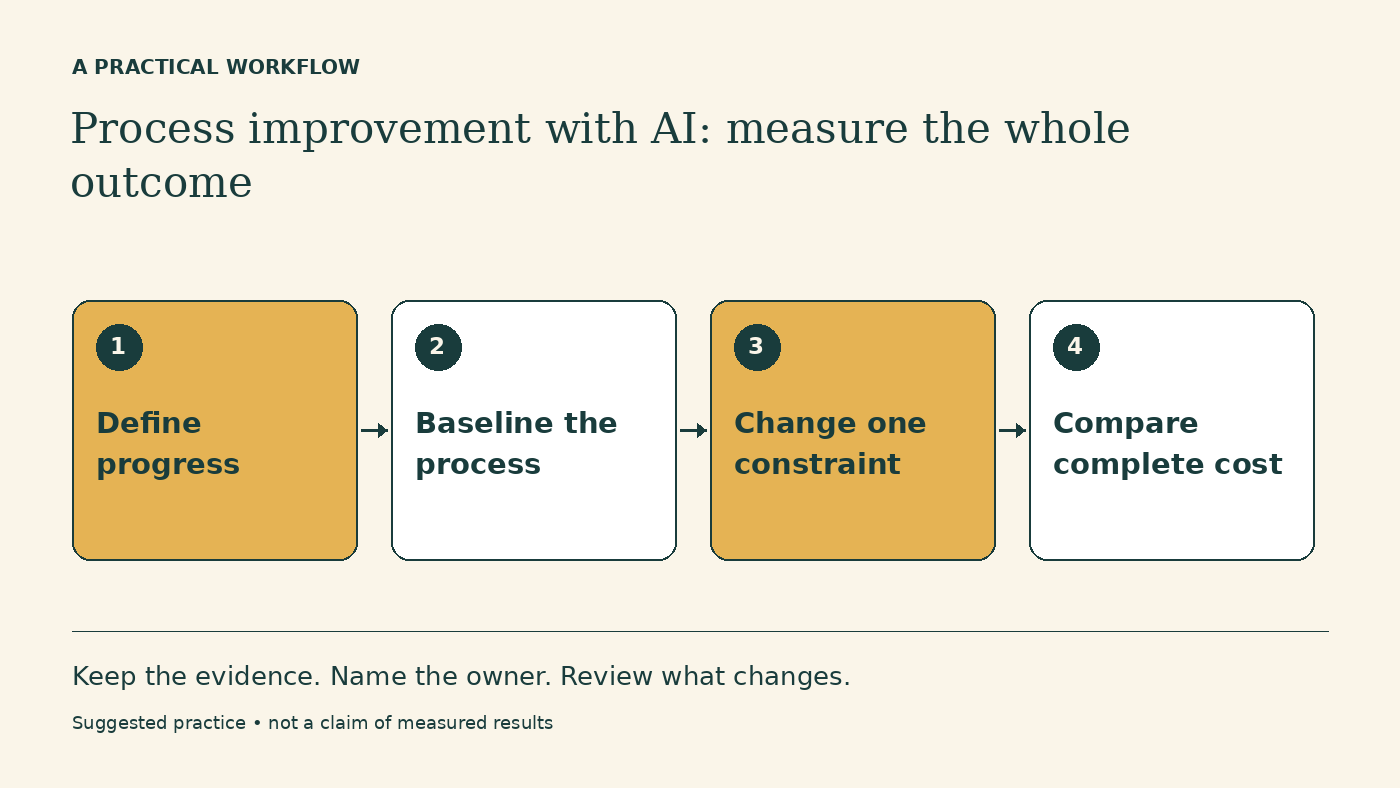
Define the customer outcome, baseline the complete process, improve one constraint, and measure review, rework, and downstream effects before expanding automation.
An AI workflow can produce a deliverable faster while making the surrounding service harder to run. A summary may need extensive checking. A routing decision may send work to the wrong queue. A faster response may leave the customer's problem unresolved.
Process improvement begins by defining what better means for the person receiving the work. For onboarding, that might be completing a first useful task. For a support request, it might be reaching a correct resolution without repeating the story.
Draw the measurement boundary
Write the starting event, ending event, eligible cases, and important exclusions. Decide whether you are measuring elapsed time, employee effort, cost, customer progress, or a combination. Use the same definitions before and after a change.
Include the downstream step. If automation saves ten minutes in one department and creates fifteen minutes of repair elsewhere, the local improvement hides a system-level loss. Record who performs the repair so that work does not disappear from the evaluation.
Identify the constraint through real cases
Observe successful, delayed, and failed cases. Distinguish incomplete information, waiting, repeated approval, technical failure, and uncertainty about the decision. A count of process steps alone cannot tell you which step is worth changing.
DORA's 2025 research describes AI as amplifying strengths and weaknesses in the surrounding organization. That finding concerns software delivery. Applying a whole-process lens to another business workflow is a recommendation here, not a claim that the report measured your industry or team.
A worked example: onboarding review
Imagine a hypothetical service whose staff prepare an onboarding recommendation. The current task takes 30 minutes of human work. An AI draft takes 4 minutes, followed by 16 minutes of review and 5 minutes of correction. The new human effort is 21 minutes if the generation runs unattended; elapsed time depends on the sequence and queues.
Those illustrative numbers show why definitions matter. Count human effort separately from elapsed time and tool cost. Also check whether the recommendation is correct and whether the customer reaches the intended next step. Saving effort on an unusable result is not a useful gain.
Use a balanced pilot scorecard
- Customer progress: did the eligible customer complete the intended task?
- Quality: was the output correct, complete, and appropriate?
- Effort: how much preparation, checking, repair, and maintenance was required?
- Flow: how long did the case wait between steps?
- Failure: what happened when inputs were missing or the tool was unavailable?
Choose thresholds before reviewing results. The exact thresholds depend on the work and the consequence of an error. Include cases that were routed to people so that the success rate is not inflated by silently excluding difficult work.
Compare carefully
Keep the audience, case mix, and time window as comparable as possible. Record other changes, such as new staff or a revised offer. A before-and-after improvement is an observation; it is not automatically proof that AI caused it. When practical, use a controlled comparison or phased rollout and explain the limitations.
A prompt for an outcome audit
Review this workflow and pilot data. Define the customer outcome, measurement boundary, human effort, elapsed time, quality, and exception handling. Identify costs or failed cases omitted from the current report. Separate observations from causal claims. Recommend one decision: continue, revise, stop, or gather more evidence, and explain what would change that recommendation.
Make the decision explicit
At the pilot review, name what you learned and what remains uncertain. Expand only the part that has earned confidence. Retiring an automation that shifts effort or weakens the experience is a successful improvement decision, even when its demonstration looked impressive.
Continue with a related guide
- Forward-deployed product managers: turn customer reality into product decisions
- Agile in the AI era: inspect outcomes before increasing output
Apply this with a practical template
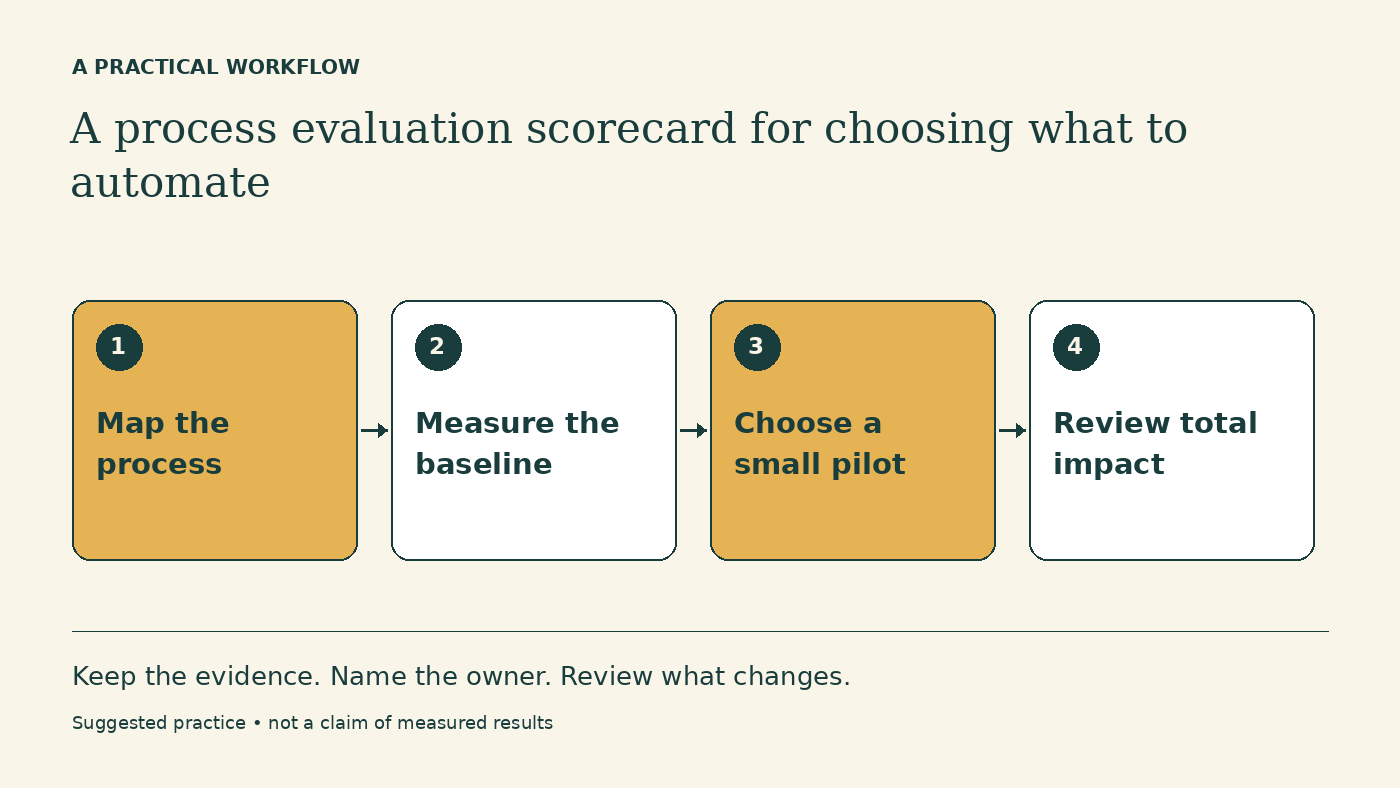
A process evaluation scorecard for choosing what to automate
Questions you might be asking
Is time saved enough to justify automation?
It is one measure. Check usable quality, customer progress, exception costs, and the effort required elsewhere in the process.
Can I claim the automation caused a higher conversion rate?
Only when the evaluation supports that conclusion. A simple before-and-after comparison may be affected by other changes.
Sources and further reading
Sources checked October 16, 2026. Tool features and plan availability can change; review the linked publisher documentation before connecting an account.
Put one idea to work
Define the customer outcome, smallest useful deliverable, evidence, and review decision before expanding the work.
Plan an expertise pilot →Explore more from Outcome DrivenKeep practicing
 Process improvement
A process evaluation scorecard for choosing what to automate
Compare workflow problems, baseline effort, exceptions, and customer outcomes before choosing an automation pilot.
October 16, 2026 · 4 min read Evidence and decisions
Connected data needs a decision brief, not another confident summary
Turn AI-assisted analysis into a useful product or growth decision with metric definitions, competing explanations, and explicit evidence gaps.
October 16, 2026 · 6 min read