Agile and outcomes
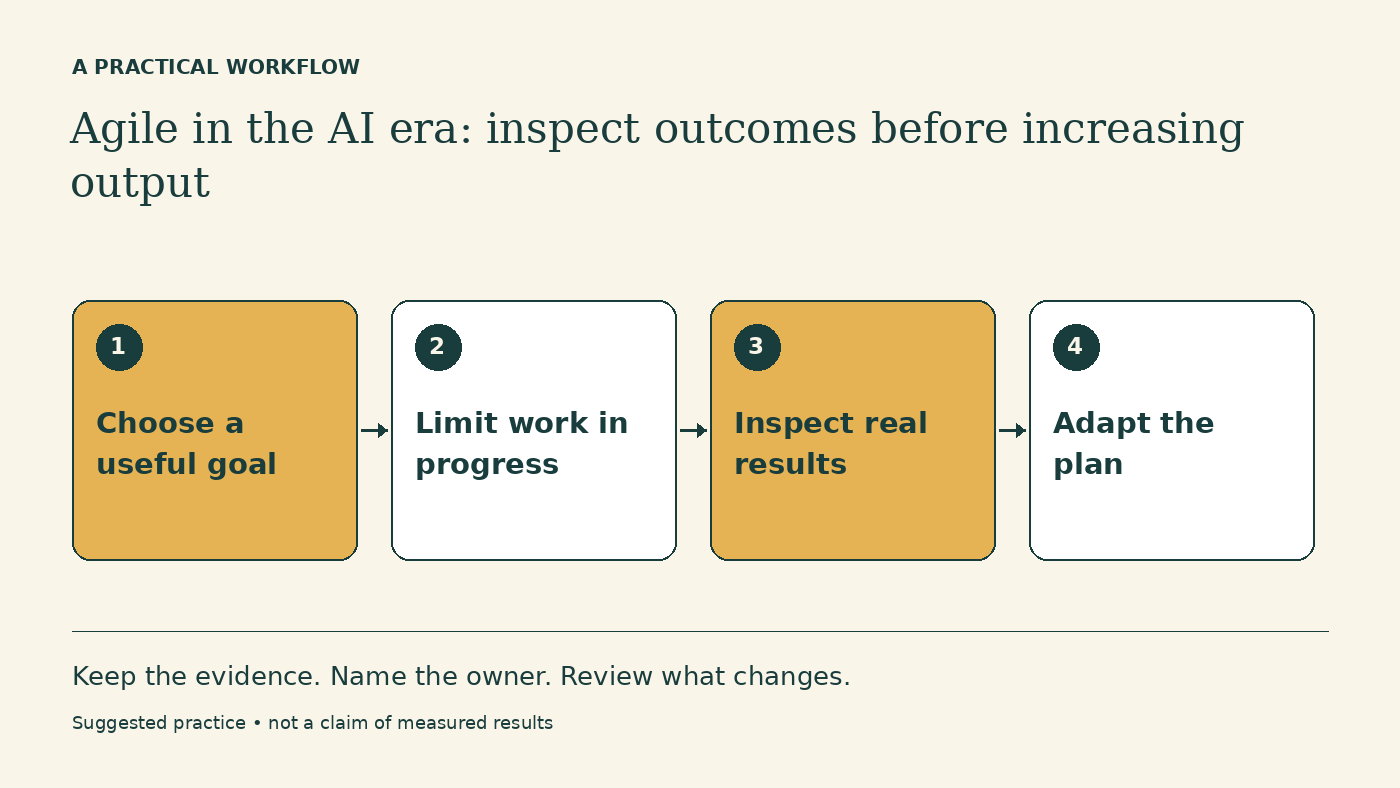
Agile in the AI era: inspect outcomes before increasing output
Use faster production to shorten learning loops while tracking quality, customer progress, and the work your team should stop.
In this guide
- The useful starting point
- Change the unit of discussion
- Protect the review constraint
- A worked example: onboarding experiments
- Keep quality inside the delivery conversation
- Use the retrospective to change one thing
- Know what you are practicing
- Continue with a related guide
- Apply this with a practical template
- Questions you might be asking
- Sources and further reading
The useful starting point
Agile remains useful when it supports feedback, adaptation, collaboration, and sustainable delivery. With AI, inspect whether faster output produces useful changes and keep unfinished work within the team’s review capacity.
When generating a draft or a code change becomes cheaper, teams can start more work than they can evaluate. The visible backlog moves, but the review queue grows. Customers may receive more changes without receiving a better experience.
The response is to make the learning loop explicit. Decide what should improve, deliver a small change, inspect the evidence, and adapt. That is a practical application of agile principles to a new production environment, not a prediction that one process will fit every team.
Change the unit of discussion
Instead of asking how many outputs AI produced, ask which uncertainty the team resolved or which customer task improved. Output still matters: a useful idea must become something people can use. But ticket counts and draft counts are incomplete measures of progress.
A good goal states the intended change in behavior or capability. For example, help a new user complete an import without asking support. The work may include clearer instructions, a smaller interface change, or better error recovery. Generating a large feature is only one possible response.
Protect the review constraint
Set a limit on work in progress that reflects the people available to inspect and maintain it. AI-generated work still needs context, testing, and a decision. If review is the bottleneck, producing more patches can increase delay.
Make the queue visible. Record the reason work waits: missing evidence, unclear scope, test failures, or reviewer capacity. Improve that condition before increasing throughput. A small, understandable change is often easier to learn from and reverse.
A worked example: onboarding experiments
Imagine a hypothetical team that can now generate five onboarding variants in an afternoon. It chooses one clear question: do users understand the file requirements before uploading? The team compares two explanations and defines the eligible audience and observation window.
Before launch, it checks accessibility, instrumentation, and what happens when a file fails. After launch, it inspects completion and errors, along with qualitative feedback. It records changes in traffic mix and avoids attributing every movement to the new wording.
The other three variants remain ideas. Producing them did not create an obligation to ship them. The experiment earns value by improving a decision about the customer experience.
Keep quality inside the delivery conversation
Include defects, rework, support load, and recovery effort when discussing speed. DORA's 2025 report emphasizes the surrounding organizational system in AI-assisted delivery. It does not justify a universal productivity multiplier or a fixed reduction in team size.
If a team celebrates output while absorbing more incidents, its scorecard is incomplete. Agree on a quality threshold and review exceptions openly. A deadline does not make an unverified result ready.
Use the retrospective to change one thing
Ask what helped the team learn, what created unnecessary work, and which assumption survived without evidence. Choose one improvement for the next cycle. It could be a clearer acceptance criterion, a smaller batch, or removing an approval that adds no useful judgment.
Review this delivery cycle against our customer goal. Separate completed output, observed customer progress, quality issues, and unresolved assumptions. Identify the main queue or rework source. Propose one process change and the evidence we should collect next. Do not infer productivity from ticket count alone.
Know what you are practicing
Agile is broader than Scrum, and a custom weekly review is not automatically Scrum. Use the language accurately. Whatever approach you choose, preserve the ability to inspect real work, change course, and maintain a pace that people and systems can sustain.
Continue with a related guide
- Process improvement with AI: measure the whole outcome
- Forward-deployed product managers: turn customer reality into product decisions
Apply this with a practical template
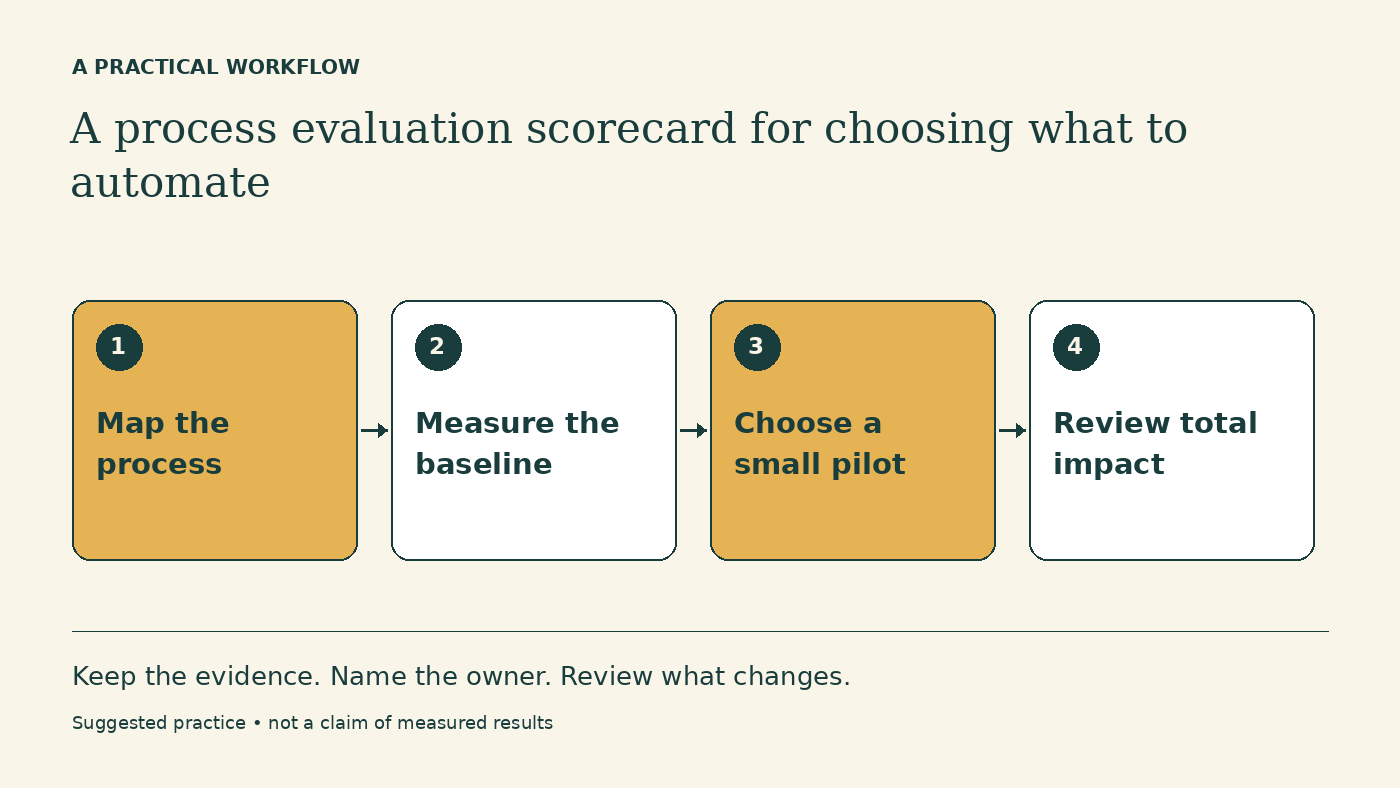
A process evaluation scorecard for choosing what to automate
Questions you might be asking
Is agile obsolete because AI writes code quickly?
Faster production does not remove uncertainty or the need for feedback. Agile principles can still guide how teams inspect and adapt.
Should we increase our delivery target after adopting AI?
First measure the complete system, including review, defects, and maintenance. Local drafting speed does not establish sustainable delivery capacity.
Sources and further reading
Sources checked October 16, 2026. Tool features and plan availability can change; review the linked publisher documentation before connecting an account.
Put one idea to work
Define the customer outcome, smallest useful deliverable, evidence, and review decision before expanding the work.
Plan an expertise pilot →Explore more from Outcome DrivenKeep practicing
 Process improvement
A process evaluation scorecard for choosing what to automate
Compare workflow problems, baseline effort, exceptions, and customer outcomes before choosing an automation pilot.
October 16, 2026 · 4 min read Evidence and decisions
Connected data needs a decision brief, not another confident summary
Turn AI-assisted analysis into a useful product or growth decision with metric definitions, competing explanations, and explicit evidence gaps.
October 16, 2026 · 6 min read