Product leadership
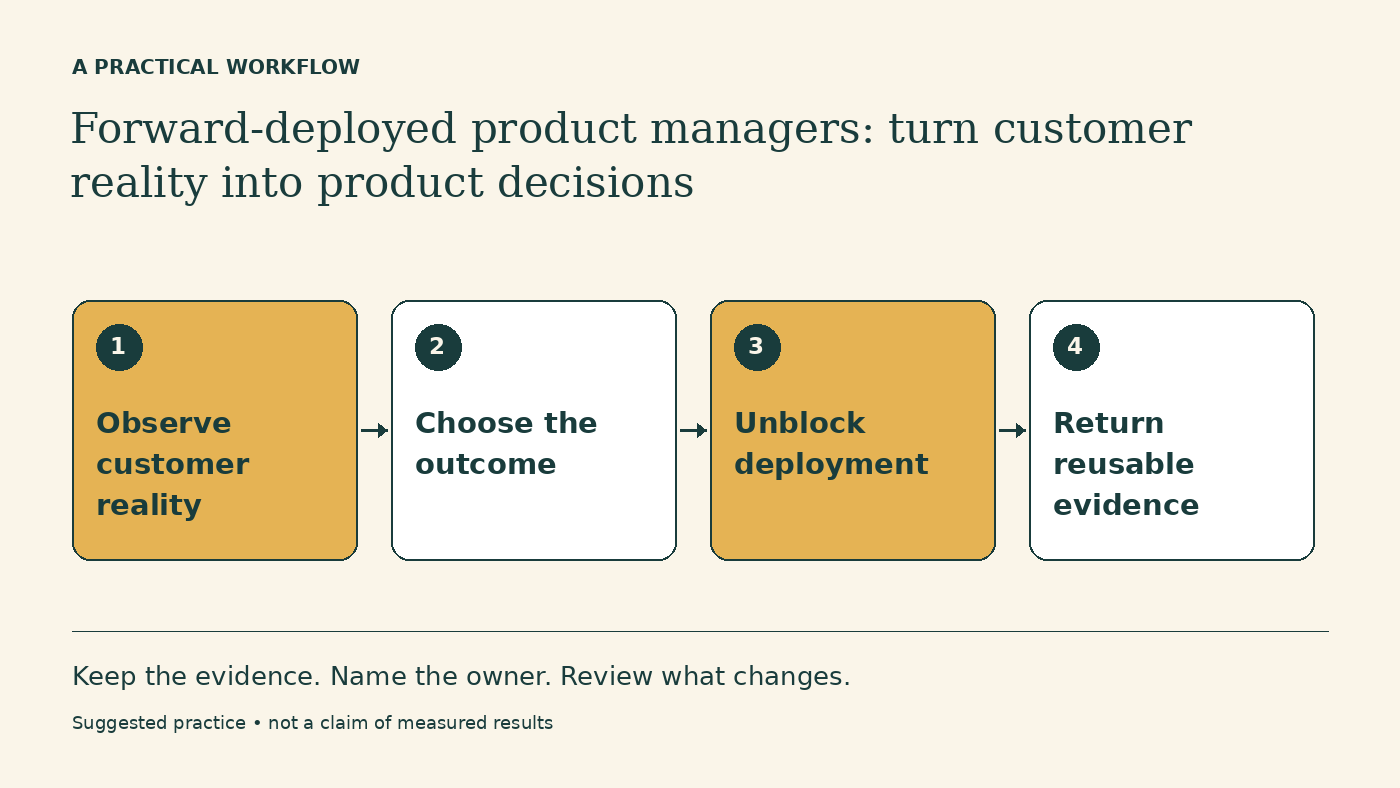
Forward-deployed product managers: turn customer reality into product decisions
Define the role through deployment outcomes, evidence, and the boundary between a customer request and a reusable product capability.
In this guide
- The useful starting point
- Begin with an outcome contract
- Separate four kinds of blockers
- A worked example: a stalled deployment
- Return evidence that the platform team can use
- A prompt for a field product brief
- Define the handback
- Continue with a related guide
- Apply this with a practical template
- Questions you might be asking
- Sources and further reading
The useful starting point
A forward-deployed product manager works close to customer implementations, owns product decisions in that context, and turns field evidence into useful input for the core product. Scope and authority vary by employer.
Forward-deployed product management brings product judgment closer to the place a product must work. Scale AI's published role describes ownership of enterprise product outcomes and collaboration with deployment engineers. That is an example of one employer's model, not a universal job definition.
The practical opportunity is to shorten the distance between a customer's operating reality and a product decision. The risk is becoming a feature-request relay or an account-specific delivery manager without the authority to address the underlying problem.
Begin with an outcome contract
Write the customer task, the users affected, the current obstacle, and the evidence that would show progress. Agree on a sponsor, an operational owner, and a person who can make product tradeoffs. Define what the engagement includes and what it cannot promise.
A contract might say that a support team should route an eligible case correctly using an approved workflow. It should not simply say launch the AI feature. Deployment is a milestone; useful adoption requires people to accomplish something with it.
Separate four kinds of blockers
- Product: the supported behavior cannot meet the essential need.
- Integration: required data or systems do not connect reliably.
- Process: ownership or operating rules are unclear.
- Adoption: people cannot understand, trust, or use the change.
The PM does not personally fix every blocker. They identify the right owner, clarify the consequence, and keep the outcome visible. An engineer may solve an integration issue, while an operations leader resolves an approval rule. Labeling both as feature requests would produce an unhelpful backlog.
A worked example: a stalled deployment
Imagine a hypothetical enterprise customer piloting an AI-assisted case review. The sponsor asks for a new dashboard because usage is low. Interviews and observation reveal that reviewers cannot tell which source supported a recommendation and are afraid to act on it.
The forward-deployed PM proposes a smaller change: show the supporting evidence, make uncertainty visible, and route ambiguous cases to an existing reviewer. Design tests the interaction; engineering checks the data and permissions; operations agrees on who handles exceptions.
The team observes whether eligible reviewers use the workflow correctly and whether cases move forward. It also records incorrect recommendations and review effort. A successful demo alone does not settle those questions.
Return evidence that the platform team can use
Write a field note with the affected task, observed failure, environment constraints, workaround, and evidence. State whether the issue has appeared in other accounts. Distinguish a reusable capability from a customer-specific configuration.
A credible note might say that two customers need traceable source references for a particular decision, with examples attached. It should not claim every customer needs a new dashboard. The core team can then compare the evidence with strategy and maintenance cost.
A prompt for a field product brief
Use these approved deployment observations to create a product brief. Separate the stated request, the observed problem, and the proposed outcome. Classify blockers as product, integration, process, or adoption. For each option identify the customer-specific part, reusable capability, evidence gaps, owner, and acceptance criteria. Do not promise roadmap dates or infer demand from a single account.
Define the handback
Before the engagement ends, confirm who owns the configuration, support path, instrumentation, and unresolved decisions. Record which improvements were verified and which are still hypotheses. The role creates lasting value when field learning improves both the customer's work and the product team's next decision.
Continue with a related guide
- Process improvement with AI: measure the whole outcome
- Agile in the AI era: inspect outcomes before increasing output
Apply this with a practical template
A process evaluation scorecard for choosing what to automate
Questions you might be asking
Is this the same as customer success?
Responsibilities may overlap, but a forward-deployed PM role should clarify product decision ownership and how field evidence affects delivery and the core product.
Should every customer request become a roadmap item?
No. Evaluate the underlying problem, reuse potential, strategic fit, and long-term support cost.
Sources and further reading
Sources checked October 16, 2026. Tool features and plan availability can change; review the linked publisher documentation before connecting an account.
Put one idea to work
Define the customer outcome, smallest useful deliverable, evidence, and review decision before expanding the work.
Plan an expertise pilot →Explore more from Outcome DrivenKeep practicing
 Process improvement
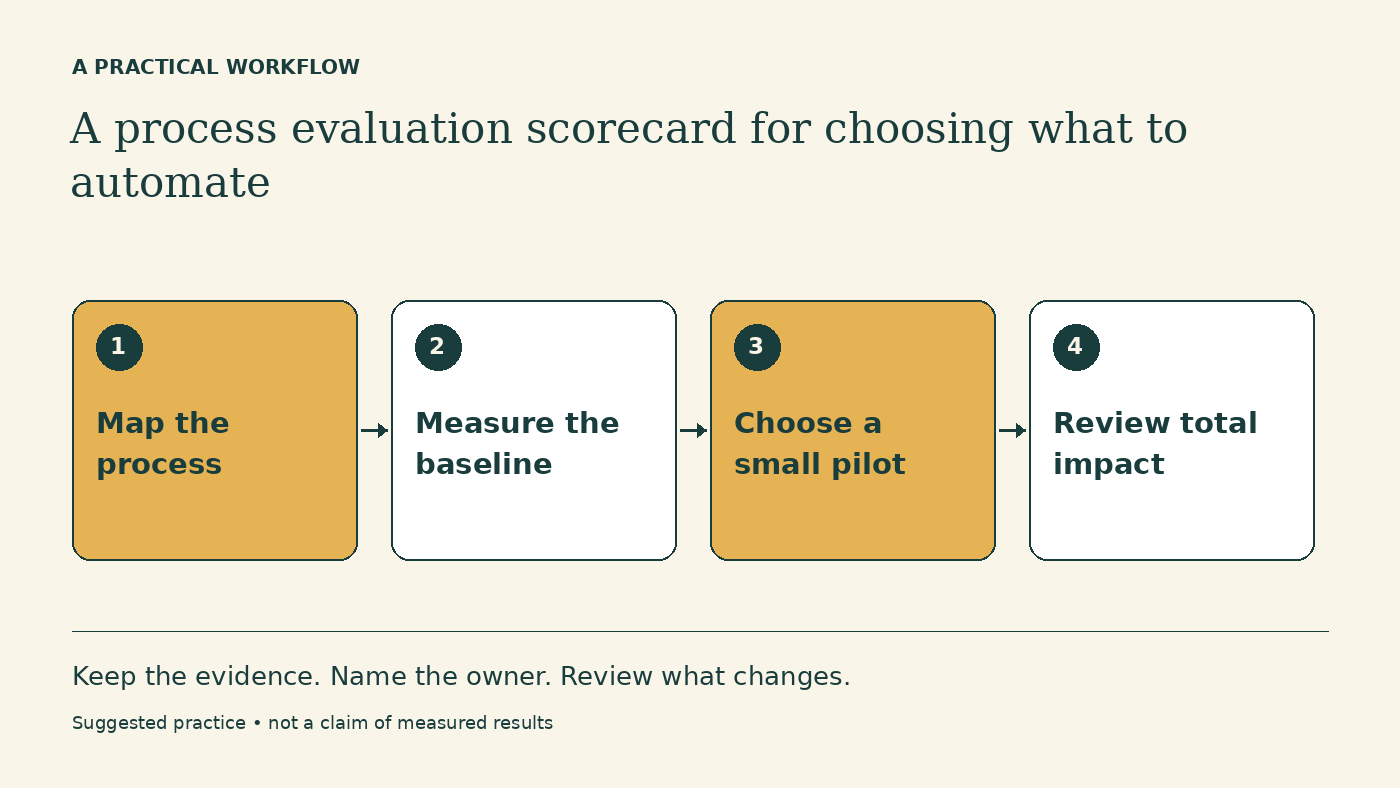
A process evaluation scorecard for choosing what to automate
Compare workflow problems, baseline effort, exceptions, and customer outcomes before choosing an automation pilot.
October 16, 2026 · 4 min read Evidence and decisions
Connected data needs a decision brief, not another confident summary
Turn AI-assisted analysis into a useful product or growth decision with metric definitions, competing explanations, and explicit evidence gaps.
October 16, 2026 · 6 min read