

Examples are illustrative unless otherwise attributed.
Count the work and the cash
An AI-assisted affiliate campaign can produce more drafts without producing more value. To decide whether the work deserves another week, measure the recommendation, the reader's next action, and the economics separately.
Start with a clear campaign boundary: one audience, one buying question, a defined set of content, and a review period. Keep the platform's records and your own costs beside the content log.
This guide applies the cost-per-accepted-result approach to affiliate publishing. The numbers below are a fictional teaching example, not a benchmark or portfolio result.
Define acceptable content first
A usable guide should answer a specific question, support its factual claims, explain tradeoffs, and identify any commercial relationship. A reviewer should be able to tell what was personally tested, what comes from an official source, and what remains unknown.
Google's review guidance encourages original evidence and comparisons that help a reader make a decision. Use that as a quality prompt, not a guarantee of rankings. Google's review guidance
Record whether each draft passes the agreed review. Include the time spent researching, correcting, and checking it. Measuring only generation time hides work that may determine whether AI is useful.
A faster draft is an input. A useful recommendation and a sustainable result are the tests.
Separate the stages after publication
| Stage | What it shows | What it does not establish |
|---|---|---|
| Page visit | Someone or something reached the content | A person understood or trusted it |
| Affiliate-link click | A recorded click toward the merchant | A qualifying purchase |
| Attributed action | The platform attributed an action under its rules | Final commission approval |
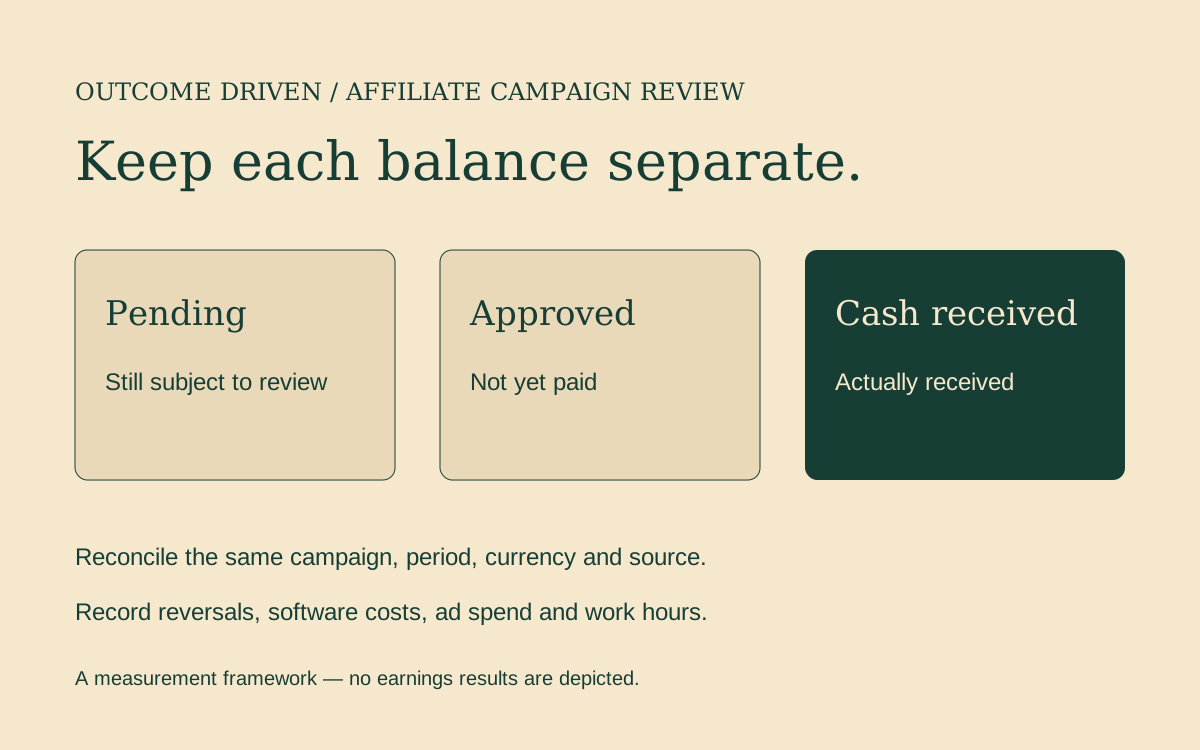
| Pending commission | A provisional amount is recorded | Revenue you will definitely retain |
| Approved commission | The platform has approved the amount | Money has reached your bank |
| Paid commission | A payment has been issued or received, as recorded | That the whole campaign was profitable |
Use the same definitions each time. If your analytics count outbound events and the affiliate platform counts clicks differently, retain both labels. Do not quietly combine them into one supposedly exact rate.
Keep a cohort and an as-of date
Affiliate decisions can mature after the content's reporting week. Returns, exclusions, and approval schedules can change the amount. Track the cohort of clicks or actions from a given period, then record its status as of a later date.
Keep a second view for cash received during the current month. A payout this month may relate to last month's content. That distinction helps explain why campaign performance and cash movement can tell different stories.
Missing information should remain unknown. A blank commission field is not automatically zero. If the platform provides only aggregate reporting, document that limitation rather than inventing attribution to an individual article.
Work through a fictional example
Imagine a small campaign with one approved comparison guide and two supporting posts. The campaign records 300 page visits, 60 affiliate-platform clicks, and three attributed orders. As of the review date, one order has an approved $20 commission and two have pending commissions totaling $40. No payout has arrived.
The creator allocates $15 of software expense and $5 of asset costs to this campaign. Research, editing, and review took two hours, valued at $40 per hour for this exercise.
| Calculation | Fictional result |
|---|---|
| Attributed orders ÷ platform clicks | 3 ÷ 60 = 5% |
| Approved commission | $20 |
| Pending commission, shown separately | $40 |
| Allocated cash costs | $20 |
| Approved commission less cash costs | $0 |
| Labor value assumption | 2 × $40 = $80 |
| Approved contribution after allocated labor | −$80 |
| Cash received less cash costs so far | −$20 |
The 5% figure describes attributed orders in this fictional sample. It is not a stable forecast, an approved-commission conversion rate, or evidence that AI caused the orders. Pending amounts may change, and the campaign needs more time before some economic questions can be answered.
Include the effort that makes the work usable
For each content item, record research time, drafting time, review time, correction time, and maintenance. Add tool charges and agreed allocations of subscriptions. Count failed drafts in the cost total.
If three drafts cost $60 in allocated tools and labor but only two meet your publishing standard, the operational cost is $30 per accepted draft. That is a production measure. It still does not show whether readers benefited or whether the affiliate offer converted.
Use a consistent allocation method. Do not assign the full monthly software bill to every campaign, and do not omit it everywhere. Keep the method visible so the result can be interpreted.
Use AI to prepare the review
Give the assistant an anonymized table, the definitions, and the review date. Request observations first, then possible explanations and a small next experiment.
Review this campaign table as of [date]. Keep pending, approved, and paid commissions separate. Preserve missing values. Recalculate the stated rates, show the denominators, and flag inconsistent periods. Identify one question the data cannot answer and propose a bounded test. Do not claim causation, profitability, or a winner beyond the evidence.
Check the calculations against the original records. Commercial disclosures remain part of the experience being measured: readers need to understand the recommendation's financial relationship. FTC disclosure guidance
Choose the next decision
Low qualified traffic calls for a different response from many clicks with few attributed actions. Heavy review effort points to source quality, scope, or draft quality. Pending commissions call for a later reconciliation, not an immediate claim of success or failure.
Write one next action, its owner, the measure, and the review date. Continue, change, or stop based on what you can establish. Keep uncertain explanations labeled as hypotheses.
Practice with the free Customer Outcome Lab or use the First-Win Field Kit to define a useful next step. If you need help implementing a site and its reporting handoffs, explore AI Affiliate Launch or book a fit call.
Download a working scorecard
Use the free campaign planner and download its scorecard. Keep amounts in distinct stages and state the reporting period, currency and source export.