
Start after the content is seen
Impact’s creator workflow article offers a useful campaign structure. Our extension is to follow the customer after the click.
A campaign can generate attention while leaving customers unsure which option to choose, unprepared for setup or disappointed by the product. The measurement plan should examine that experience. Otherwise, a successful-looking acquisition report can hide an expensive handoff problem.
Name the customer’s next useful result
Choose an outcome the campaign can reasonably help. For a fictional scheduling product, the customer might need to understand whether it supports their working hours and then publish a usable booking page. A click on a creator’s tutorial is an earlier signal, not that result.
Define what completion means and what evidence would establish it. Distinguish an attempted setup from one that works. Keep the definition stable during the review period so improvements are not created by moving the goalposts.
Define the customer result before you measure campaign success.
Build a scorecard across the handoff
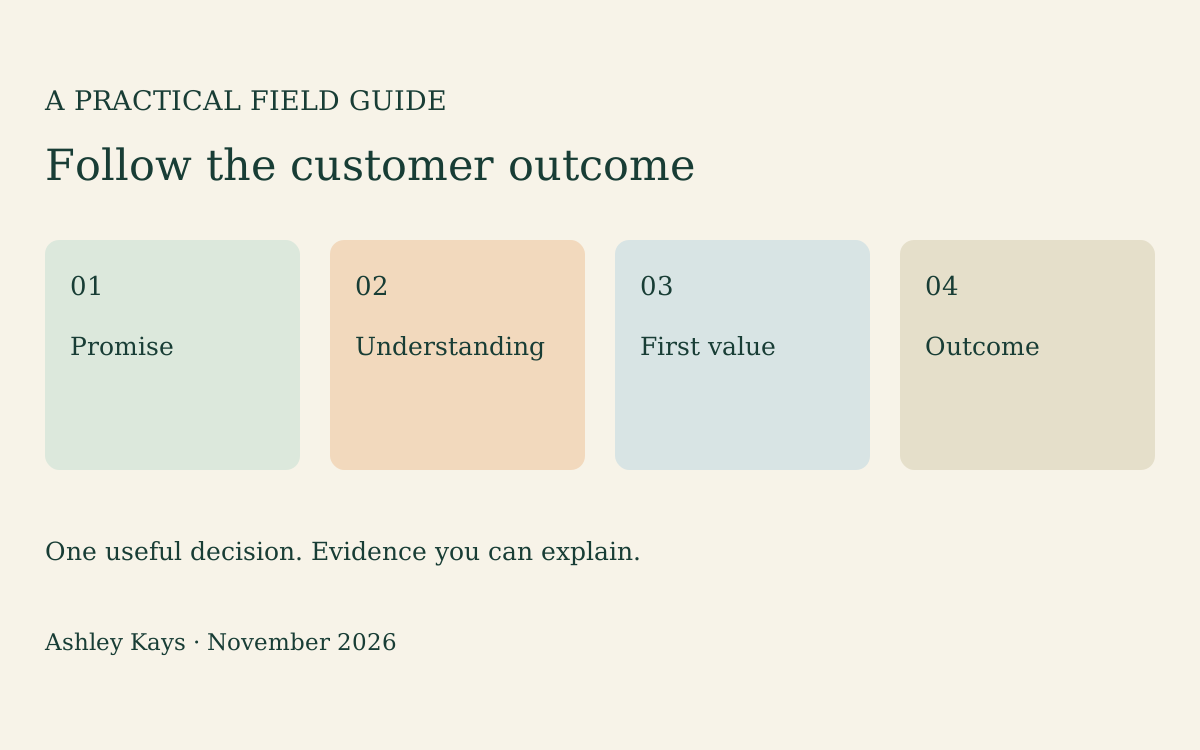
| Moment | Question | Evidence |
|---|---|---|
| Promise | Did the content describe the offer accurately? | Reviewed asset and approved facts |
| Understanding | Can the intended buyer judge fit? | Usability observations and recurring questions |
| First value | Did the buyer complete the useful task? | Verified completion event and time window |
| Business result | Did the relationship create value at a reasonable cost? | Qualified outcomes, costs, refunds and retention |
Give each measure an owner, denominator and review date. Report missing instrumentation as missing. Keep research participants separate from ordinary customer cohorts unless the analysis explicitly accounts for the difference.
Choose an AI task that supports the evidence
AI can group de-identified customer questions, compare a draft brief with approved facts or summarize a campaign review. Require links back to the supplied evidence and retain disagreement. Do not ask it to invent missing events or assign causal credit from a collection of anecdotes.
For the scheduling example, grouped questions may reveal that people do not understand time-zone behavior. The appropriate fix could be a clearer demonstration and setup explanation. It may have little to do with finding a larger creator.
Use attribution and experiments for different questions
Tracked links can help describe recorded paths. They cannot reveal every earlier influence or prove the customer would not have converted otherwise. A customer-reported discovery answer adds context but comes with memory and response bias.
When the stakes justify it, plan a suitable controlled comparison with a defined unit of assignment, outcome window and contamination checks. For smaller programs, combine a transparent observational report with qualitative follow-up. Label its limitations rather than presenting it as incremental lift.
Make a decision that includes customer quality
Before the campaign, decide what would justify continuing, revising or stopping. A campaign that attracts more low-fit customers may increase revenue briefly while adding returns and support work. A smaller stream of well-informed customers may be healthier.
Review the promise, handoff and economics together. Keep the content that helps people make a sound choice. Improve the step where they get stuck. Stop claims or workflows that cannot be supported. The purpose of the scorecard is a better decision, not a larger collection of metrics.
Put it to work
Use the experiment canvas to define one customer outcome, its evidence and a decision rule before briefing your next creator.
Sources and editorial context
Reviewed November 3, 2026. This is independent editorial analysis. The exercises, sample briefs and decision rules are our recommendations; they are not results reported by the sources or measured client outcomes.