


A support assistant answers immediately. It recognizes the account, apologizes and offers to escalate. Then the person who takes over asks the customer to explain everything again. The first response was fast. The experience still failed.
That gap deserves its own product work. A handoff is the moment responsibility moves between people, software or channels. Its quality depends on what travels with the request and whether anyone actually accepts the next action.
What this week’s evidence supports
Twilio’s November 9, 2026 survey release reports satisfaction beliefs of 86% among businesses versus satisfactory AI experiences reported by 51% of consumers. Its 7,652 consumers and 660 leaders came from 18 markets; these are separate populations, not matched customer–company pairs. The research measures perceptions, not verified resolution or causal lift.
Qualtrics’ November 12 release, summarizing 43.1 million patient encounters, reports ambulatory-surgery recommendation scores of 51.8 with operational friction versus 88.7 without it. This observational healthcare comparison cannot establish causation or predict ecommerce revenue. It makes coordination a worthwhile hypothesis to investigate.
Our practical thesis: measure the transition itself, then test whether improving it helps people finish. The following onboarding case is a fictional teaching example, not a measured client result.
1. Define the customer’s finish line
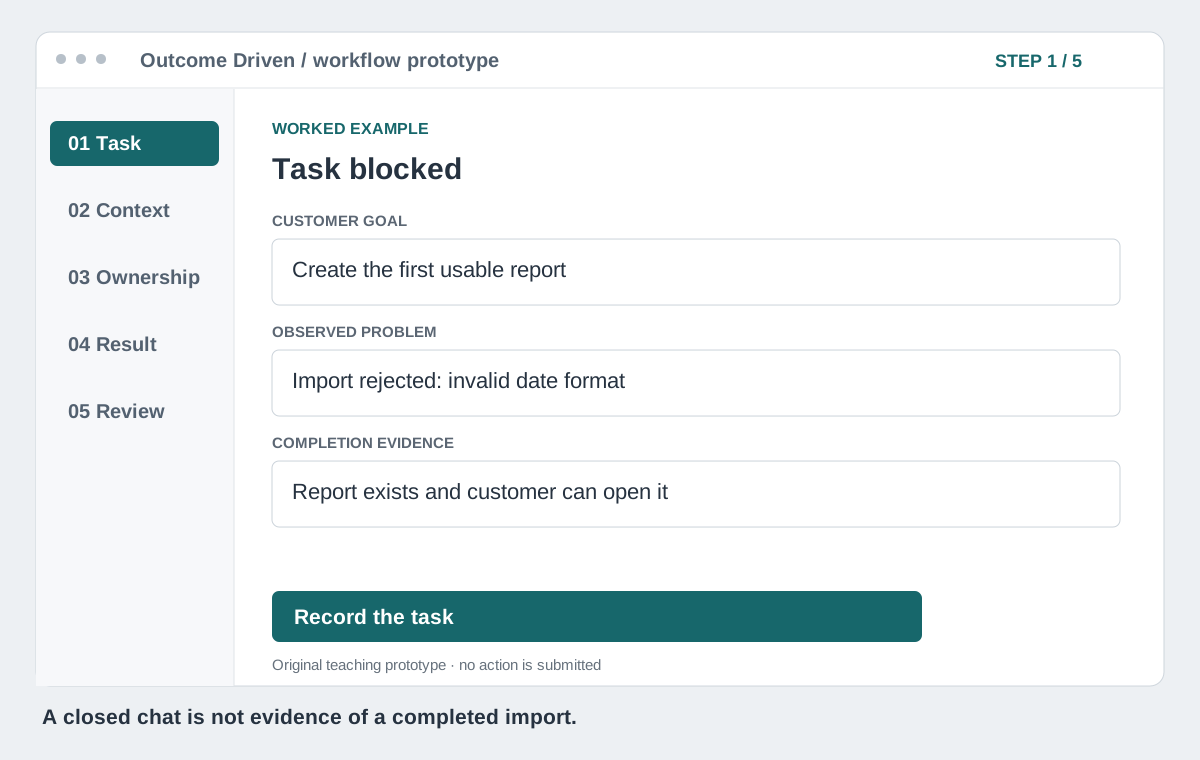
Imagine a new software customer whose first data import fails. “Reply sent” is an internal event. The customer’s finish line is an import that produces a usable report. Write that definition before choosing the dashboard metric.
Select one eligible cohort: new accounts whose first import failed and who requested help. Keep people who abandon the support journey in the denominator. Otherwise an apparently better completion rate may simply exclude those who gave up. Record the failure time and the starting product state.
2. Make context portable and editable
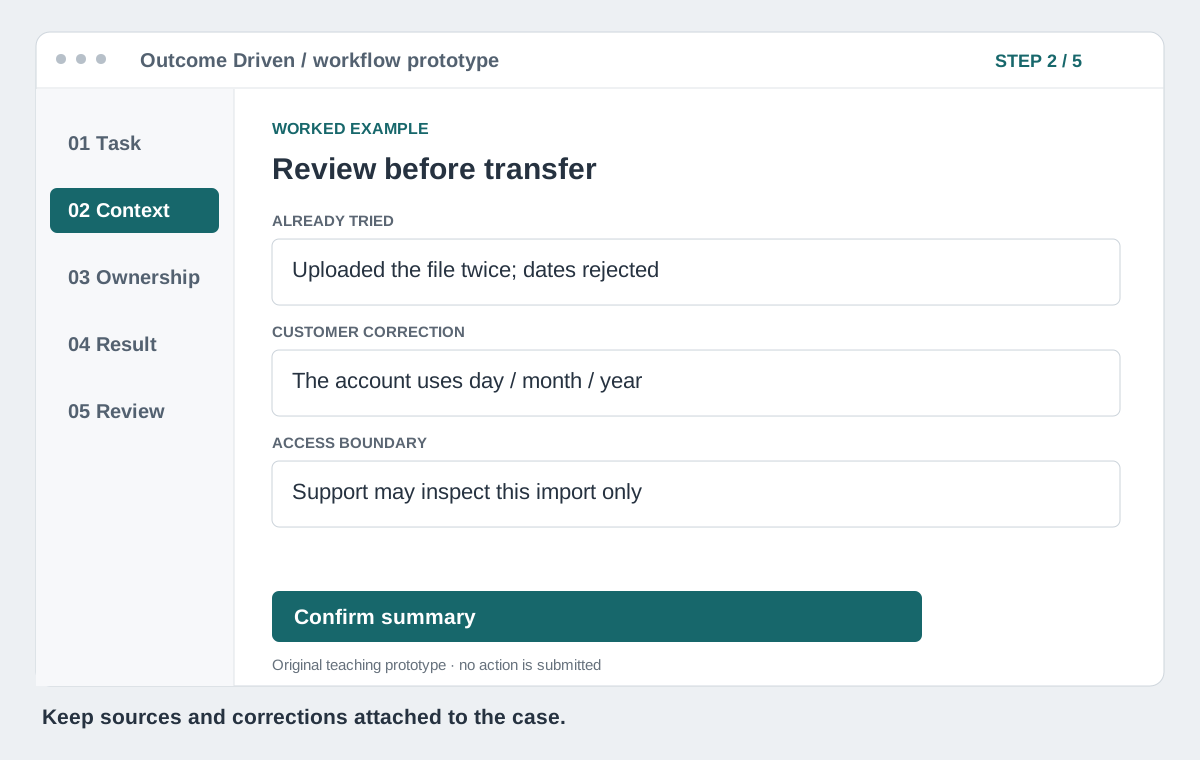
The receiving person needs a concise case record: goal, current state, attempts, unresolved question and permission boundaries. Link to the source of important facts. Let the customer correct the summary before it travels.
Do not equate context retention with copying an entire conversation everywhere. Pass only what the next role needs, with access controls and an appropriate retention period. Separate what the customer said from what the model inferred. A wrong summary can spread a mistake faster than a missing one.
3. Confirm the next owner
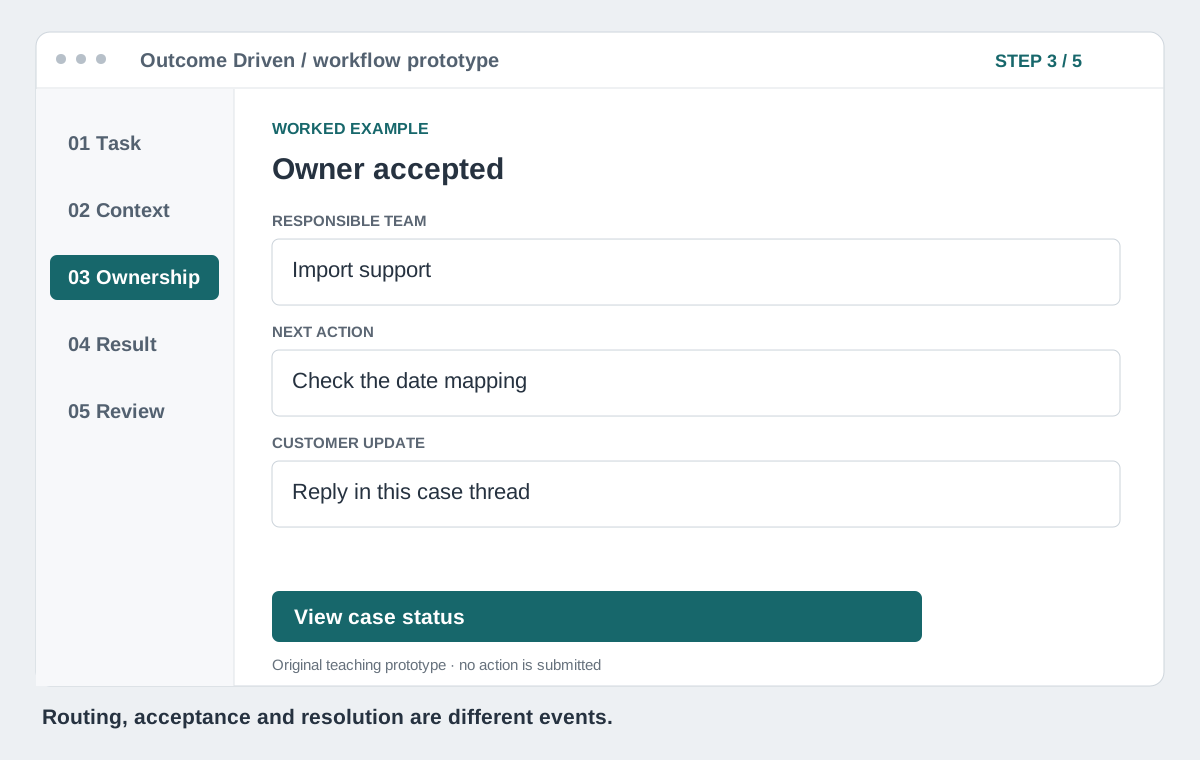
A routing event says the request moved. Acceptance says someone took responsibility. Record both. Until acceptance, show a queued state and the fallback contact route; do not imply a person is already working on it.
Tell the customer who owns the next action, how they will receive an update and what to do if that update does not arrive. An update commitment should reflect actual staffing and service capability. When no one is available, preserve the case and state that clearly.
4. Verify resolution and preserve recovery
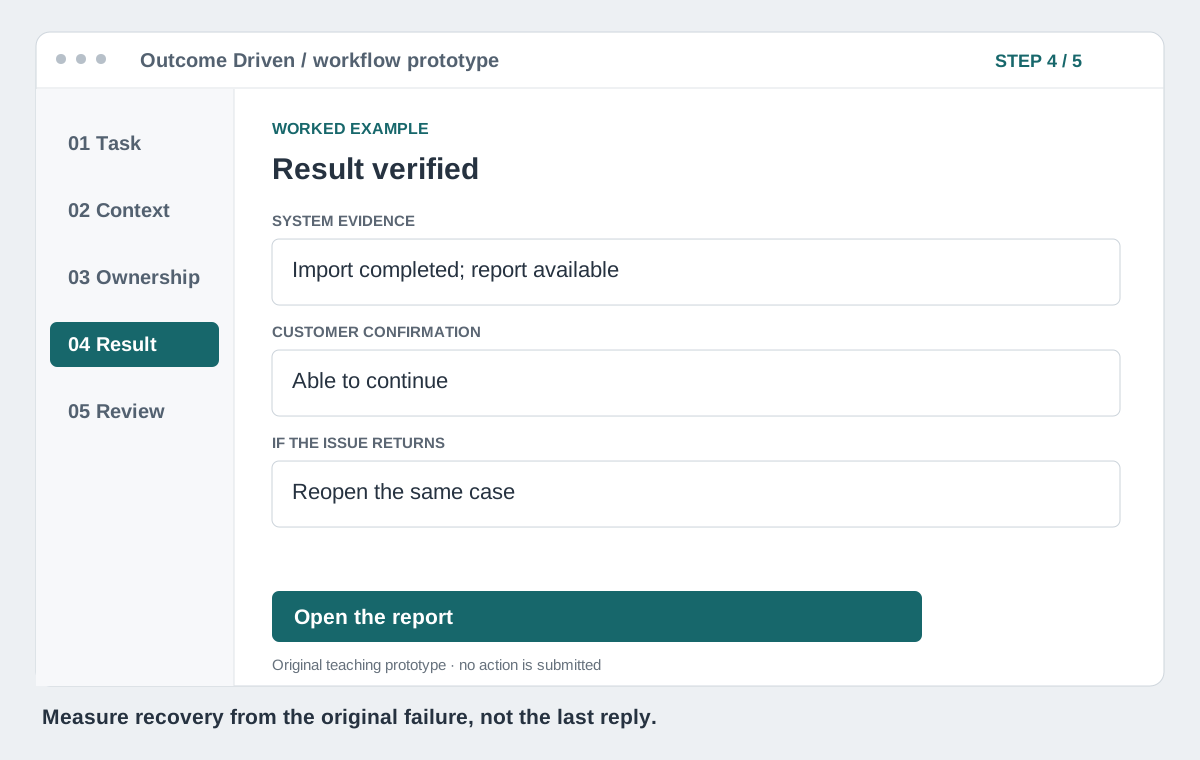
When support fixes the mapping, verify that the import succeeds and the report opens. Ask whether the customer can continue; a yes/no check is more useful here than a broad satisfaction survey. Keep technical completion and customer confirmation as separate observations.
If the import still fails, reopen the same case with its history. Never create an apparently clean new ticket that hides a repeated failure. Track time from the original failed task to verified recovery, including queue time and rework.
5. Use the Handoff Scorecard to choose one repair
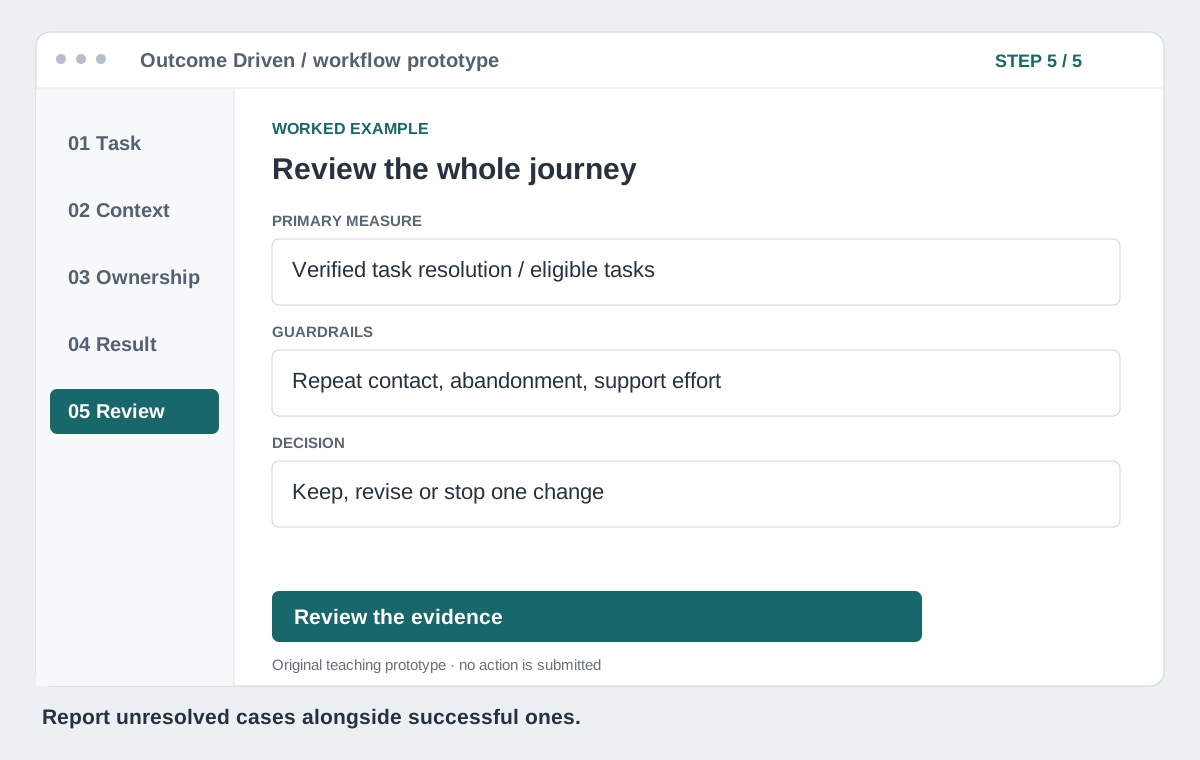
Review these measures separately. A single weighted score can hide a severe failure behind good averages. Show counts, denominators and the observation window beside each rate.
| Measure | Operational definition |
|---|---|
| Context retained | Audited accepted handoffs containing all required, correct fields / all audited accepted handoffs. |
| Repetition | Reviewed handoffs where customers repeat information already supplied / all reviewed handoffs. |
| Ownership confirmed | Requests accepted by a named team or role / all eligible transfer requests. |
| Escalation completed | Requested human transfers that reach a human / all human-transfer requests; report pending and abandoned separately. |
| Task resolved | Eligible tasks with defined completion evidence within the chosen window / all eligible tasks. |
| Recovery time | Median and 90th percentile from first failure to verified resolution; also report unresolved case count and age. |
| Later behavior | Successful next use and repeat contact within a fixed window, with comparable cohorts and mature follow-up. |
Download the Handoff Scorecard definitions (CSV) and the blank case log (CSV). Use pseudonymous case references; keep customer details in your approved support system.
A bounded test for an existing business
Start by auditing a small consecutive set of cases to understand failures. This is discovery, not proof of lift. Choose one intervention—for example, an editable transfer summary—and predefine eligibility, the primary outcome, a minimum useful improvement and a follow-up window.
Where volume permits, randomly assign eligible cases to the current or revised handoff while preserving ordinary access to help. Compare resolution per assigned case, repeat contacts, abandonment and total handling effort. Keep staffing and policy changes visible. If volume is too low, run a usability pilot and describe observed failures without claiming a statistically established conversion gain.
Speed still belongs in the scorecard. It becomes meaningful when the faster journey also preserves understanding and reaches the customer’s finish line. Start with the handoff that currently asks people to do the most repeated work.