

Examples are illustrative unless otherwise attributed.
The buyer has a specific question
A customer wants a desk lamp that frees up work space. The product photographs show a tidy desk and good light. They don’t show whether the clamp clears the lip under the customer’s tabletop. That customer still has a decision to make, and the gallery hasn’t helped them make it.
Fit uncertainty is the gap between what a shopper knows about the product and what they need to know to use it in their own situation. It could be a physical measurement, an operating constraint, compatibility with equipment they already own, or the work it takes to set something up.
Start with one recurring question. Show the answer in the fewest shots you need. Then test whether customers make more purchases they keep.
Download the product video test worksheet · Editable Markdown, no email required.
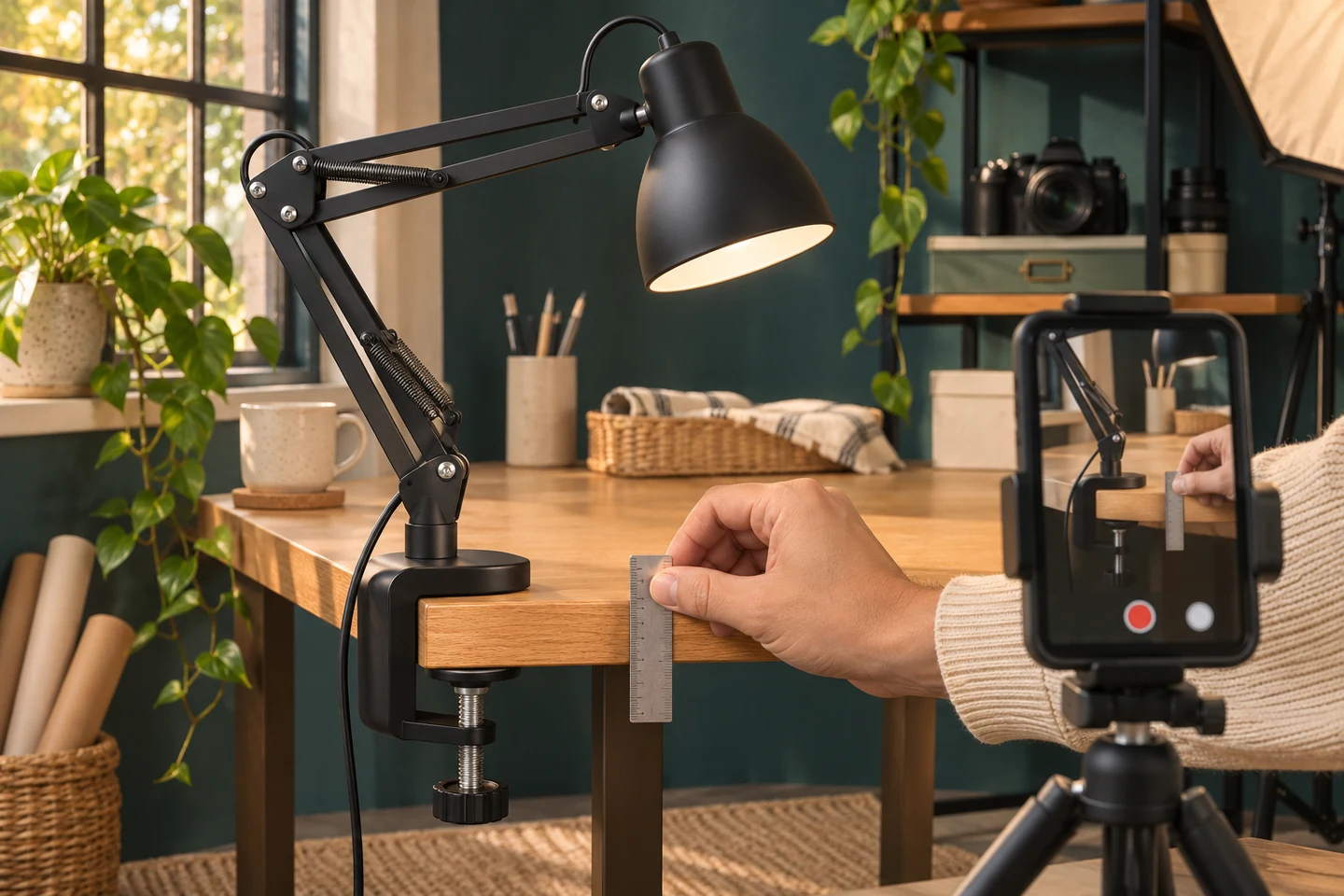
Cover: AI-generated editorial photograph of a fictional demo setup. The lamp, dimensions and test results below are teaching examples.
What the study actually supports
In a November 2026 Information & Management paper, Gong and colleagues studied 3,017,771 observations covering 540,137 products from 11,509 sellers on Weidian, a Chinese social commerce platform. Their model estimated 41.7% higher sales performance for listings with a product display video, with a larger estimated effect where seller certification and customer endorsements were weaker.
The sales analysis used historical data from April to September 2023, matching on observable characteristics and applying fixed effects. Sellers chose which products received videos, so differences the model couldn’t account for may still matter. A separate randomized follow-up supported reduced uncertainty about fit as a mechanism. It did not estimate the 41.7% sales figure. Use the paper to decide what to investigate on your store; estimate the impact with your own test.
A good demo lets a shopper decide whether the product fits their situation.
1. Find the question blocking the decision
Pull 30–60 days of product questions, return reasons and reviews for one category. Remove identifying details. Tag each record by the uncertainty it reveals: fit, compatibility, setup, usability, or quality. Keep pre-purchase questions separate from post-purchase failures; one counts hesitation and the other counts what went wrong after a sale.
In our example, shoppers ask whether the clamp opens wide enough. Returns reveal a second issue: some desks have an apron that prevents the bottom pad from sitting flat. Those are two different checks the demo needs to show.
2. Pick a product where the answer matters
Choose one stocked variant with repeated fit questions, enough eligible traffic to run a test and enough margin at stake to justify filming. Cross-check the product manual and measure a current unit. If a clearer dimension drawing answers the question just as well, put that in both versions and test what motion adds.
Keep this choice cheap: film one demo while the rest of the catalog stays as it is. A rare but expensive mistake can still justify a test. A popular item with almost no fit uncertainty may be a poor candidate.
3. Show the fit check in three shots
Open on the customer's task, then show where to measure. Use a close shot of the part creating uncertainty and one wide shot for context. Film a compatible surface and a common incompatible one. State the verified limits plainly, in captions and in adjacent page text, so a shopper can decide without playing the video. Marketing copy, price and return terms should remain consistent with the rest of the page.
Use captions, a text equivalent and a descriptive video label such as “Check whether the clamp fits your desk.” Give the poster a lightweight image and let the shopper choose to play. A production demo has to make the product easier to evaluate on a phone, too.
4. Test the offer of the video
Randomly assign eligible product-page visitors to the current gallery or the same gallery plus the fit demo. Keep the fit text in both groups if the question is whether the video itself adds value. Fix the assignment across repeat visits. If your variant also adds new specs or moves the purchase button, call it a test of that package.
Record assignment before someone chooses to watch. Compare everyone assigned to each arm, including visitors who skip playback or never buy. People who press play may already be more motivated, so comparing viewers with non-viewers will not answer the experiment question.
Use recent traffic and variability in margin to set the smallest effect that would change your decision, the required sample and the stopping rule. Define eligible products, visitor counting, the order attribution window and the deadline for returns to mature. Avoid overlapping price, promotion and inventory changes where possible. If volume is too low, first run a fit comprehension test with shoppers who bring their own measurements. That can improve the demo without claiming a sales effect.
5. Read the result after returns mature
Define contribution margin consistently across groups: subtract refunds and variable costs such as product, payment, fulfillment and return handling from collected sales. Handle recoverable returned inventory the same way in both groups. Divide by all assigned eligible visitors. Assess the fixed production cost separately when deciding whether to scale.
Here is why the denominator matters. In this made-up result, the demo sells fewer orders but produces more margin because fewer customers return the product. The numbers illustrate the decision; they are not a benchmark or a statistically evaluated result.
Ship when the estimate is useful enough to justify the cost and the guardrails are acceptable. If customers understand fit but still buy the wrong variant, improve the selection control or add a clear compatibility check. If results are inconclusive, keep the learning and decide whether more traffic could change the call.
Sources & further reading
Gong et al. · Information & Management · November 15, 2026 ↗Background references are distinguished from our original examples and proposed exercises.