


Examples are illustrative unless otherwise attributed.
Begin with an experiment contract
Before using Campaign Studio, write: “For [customer in a specific situation], [message] should produce [useful action], because [evidence]. We will review [period] and protect [quality or cost limit].” A campaign called October launch is difficult to evaluate. A campaign testing whether a reading checklist attracts suitable consultation requests has a decision built into it.
The studio does not buy placements, deliver messages, or verify your revenue. Its job is to hold a plan, create exportable artwork, and summarise measurements you enter. Inspection date for this guide: October 11, 2026.
Brand fields establish who the experiment serves
| Brand kit field | What it means and what to enter |
|---|---|
| Saved brand profiles / Create a new brand | Select an existing profile to reuse it, or start a separate profile for a different business. Save brand profile keeps this foundation available; New brand starts another profile. |
| Brand / business name | Your actual public name. Example: a fictional tutoring service called Bright Start. |
| Website (optional) | Your main business URL. This is different from the campaign destination. |
| Link to a saved Website Traffic site (optional) | Associate an existing site in your signed-in account; leave unlinked if you do not have one. |
| Who is your best-fit customer? | A specific person, situation, and need: parents of third graders who need weekday reading support. |
| Core promise / value proposition | The useful result and why the offer fits: a clear reading practice plan with a tutor. A promise needs supporting facts. |
| Verified facts we may mention | Real credentials, included deliverables, service area, or documented evidence. An empty proof field is better than invented testimonials. |
| Claims or phrases to avoid | Unsupported guarantees, unverified outcomes, sensitive assumptions, and language your brand does not use. |
| Voice and tone | Choose warm and clear, confident and direct, playful and friendly, calm and professional, or premium and minimal. This guides wording, not accuracy. |
| Primary / Accent brand colors | Primary anchors the design; accent highlights a detail or action. Check text contrast in the exported image, including on a phone. |
Treat proof and restricted claims as approval boundaries. A claim about the service’s included deliverable is different from a claim that children will improve by a certain amount. The person responsible for delivery should validate the former; the latter needs appropriate evidence. Do not let a confident tone disguise an untested proposition.
Better evidence makes the next decision more useful.
Brief fields define the eligible customer and destination
| Campaign brief field | How to fill it in |
|---|---|
| Saved campaigns / New campaign | Reuse a saved experiment or create a distinct record for a new objective, offer, or channel. |
| Campaign name | Use a recognizable label, such as reading-consult-october-linkedin. It also becomes the campaign tag in the tracked link. |
| Channel | The actual distribution destination: Instagram, Facebook, TikTok, LinkedIn, Google Search Ads, YouTube, Pinterest, Email, or Communities / partnerships. |
| Primary goal | Choose Qualified visitors, Email subscribers, Qualified leads, or Sales. Define what counts before publishing. A subscriber is not automatically a qualified lead. |
| Optional test budget (USD) | Your planned media budget, not permission to spend and not actual cost. Enter actual cost later. |
| Problem you are helping solve | Describe the customer difficulty in their language, not your product feature list. |
| Offer / what happens next | The concrete exchange: book a 15-minute reading consultation, download a practice sheet, or buy a session. |
| Landing page URL | The exact page that fulfils the ad promise. Test it, the form, and the confirmation on mobile. |
Add the decision rule to your working notes: what counts as qualified, how much evidence you need, and what would cause you to pause. For a lead campaign, a booked call from an unsuitable customer is not success merely because the form worked. Select the outcome you can reconcile with an independent business record.
Creative fields define the intervention
| Creative studio term or control | Meaning and practical use |
|---|---|
| Draft 3 messaging angles | Creates editable starting points: Relatable problem, Clear benefit, and Helpful resource. An angle is a reason to care, not a different audience. |
| Generate three angles with AI | Optional AI drafting needs an eligible account and connected provider. Review what is sent and every returned claim; availability can change. |
| Preflight review | Copy checks that flag possible issues. Passing is not proof that claims are true, the platform will approve an ad, or the campaign will work. |
| Opening hook / Headline | The hook earns initial attention; the headline states the core idea. Keep both specific and consistent with the destination. |
| Caption / primary text | The supporting explanation, evidence, and context around the main idea. |
| Call to action (CTA) | One clear next action, such as See the practice plan or Book a consultation. |
| Visual template | Editorial gradient, Calm minimal, or Split spotlight controls layout. It is not a placement recommendation. |
| Creative size | Square 1080 × 1080; Story 1080 × 1920; Landscape 1200 × 628. Check the current placement requirements and text-safe areas in the receiving platform. |
| Optional product / brand photo | Use an image you have rights to use. Current upload limit is 8 MB; the photo preview stays local and is not saved to the cloud. |
| Export editable creative PNG | The label exports a PNG: a flattened image. Edit source text in the studio and export again; the PNG itself is not a layered editable document. |
| Copy ad caption / Copy AI creative brief / Open ChatGPT | Copy text for manual use or open another tool. Opening ChatGPT does not publish an ad. |
| Save campaign & creatives | Save the working record before entering performance. This does not launch or purchase advertising. |
An angle comparison only helps if the competing treatments are recognisable. Keep a record of the actual exported file, copy, launch date, placement, audience, and destination version. The tool’s three angle labels are categories, not an immutable version history. If you edit an angle halfway through the reporting period, document that change before pooling its results.
Tracking labels are a measurement contract
The tracked URL has four core labels: source is the referrer, medium is the delivery category, campaign identifies the test, and content identifies the creative. The studio generates source and medium from the channel; for most social options the presence of a positive budget selects paid_social rather than organic_social. Google Search, email, and community options use cpc, email, and referral respectively. Review the output against how distribution actually happened.
UTMs describe acquisition; they do not prove incremental impact. Keep them out of internal navigation and avoid names or email addresses in URLs. A copied link can move to another surface, consent can reduce observability, and another device can break the recorded journey. Reconcile ad records, analytics, CRM qualification, and order data without pretending they are identical systems.
Each performance input needs a source and scope
| Results field | Definition and source |
|---|---|
| Reporting date | A date for this entry. Record the covered period and timezone in the notes. Use non-overlapping daily entries, or one consistently defined reporting interval. |
| Creative angle | The exact problem, benefit, or resource version that generated these results. Separate angle rows if you have that evidence. |
| Spend ($) | Actual media cost from the ad platform for this interval. Budget is not spend. Keep production costs separately. |
| Impressions | Times the ad was displayed, from the publishing platform. This is not unique people reached. |
| Clicks | Comparable destination/link clicks from the platform. Do not quietly substitute all interactions, profile taps, or video plays. |
| Website visits | Choose GA4 sessions for the matching tagged campaign and period, and document that choice. Sessions, users, and clicks are different units. |
| Qualified leads | Deduplicated inquiries that meet written fit criteria, checked in your CRM or lead record. A form submit alone may not qualify. |
| Sales | Completed orders or deals using one consistent definition. Keep test transactions out and account for cancellations. |
| Revenue ($) | Sales value attributable under your stated reporting method. Document refunds, taxes, currency, and attribution window consistently. |
| What did you learn? | Record period, sources, lead definition, changes, unknowns, and the next decision. Do not write “winner” from one sale. |
Choose daily, non-overlapping rows for each angle wherever practical. The reporting date does not protect you from overlap. A $50 Monday row followed by a $90 Monday–Tuesday row yields $140 recorded spend even though only $90 was spent. Separately summed nonblank fields can mix coverage periods. Keep a completeness register outside the studio when the dataset is partial.
Read the summary through the economics
| Calculated result | Formula | Illustrative answer |
|---|---|---|
| Website visits / Qualified leads | Sum of the recorded values | 150 visits / 6 leads |
| Lead rate | Qualified leads ÷ website visits × 100 | 6 ÷ 150 × 100 = 4% |
| Cost / lead | Spend ÷ qualified leads | $120 ÷ 6 = $20 |
| CTR: click-through rate | Clicks ÷ impressions × 100 | 180 ÷ 12,000 × 100 = 1.5% |
| ROAS: return on ad spend | Attributed revenue ÷ media spend | $240 ÷ $120 = 2×; not profit |
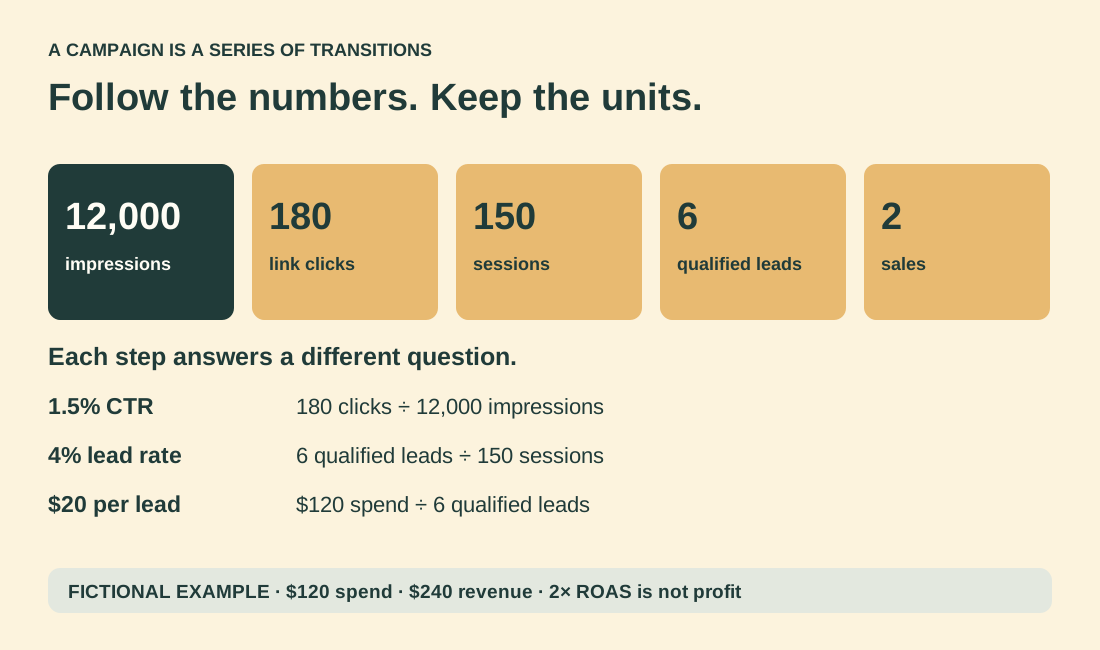
Suppose the two $120 orders generate $240 revenue but require $140 in variable fulfilment and fees. After $120 media spend, contribution is negative $20 before fixed costs. The 2× ROAS has not changed; its business meaning has. An apparent CTR winner can also create lower-quality inquiries and more sales effort. Pair the lead rate with qualification reasons and contribution per customer.
Make the record useful for the next decision
The current CSV export excludes the angle field, so preserve a version-to-angle map before analysis. The JSON campaign brief retains measurement records and their angle identifiers. There is also no dedicated subscriber metric, experiment randomisation, significance test, or automatic reconciliation with your CRM. Record these limits in the brief instead of using the interface as a substitute for them.
Choose a review action that matches the uncertainty. Broken tracking warrants repair, not an audience pivot. Several relevant visits with no usable next step warrant an experience review. A promising small sample warrants a limited follow-up test, not a claim that an angle has won. Preserve local drafts and exports; optional cloud sign-in does not automatically upload guest work or its local photo. End with a named owner, a decision date, and the observation that would change your mind.
Continue the traffic and growth learning path
Sources & further reading
Website Traffic: Campaign Studio (interface and calculation logic inspected October 11, 2026) ↗Google Analytics: Campaign URL parameters ↗Google Ads: Monitor ads and keywords ↗Google Analytics: Traffic acquisition report ↗Background references are distinguished from our original examples and proposed exercises.