AI building
Before you build with AI, decide what should get better
An outcome-first method for using ChatGPT Work or Codex to build a small app and test whether it improves the customer’s actual task.
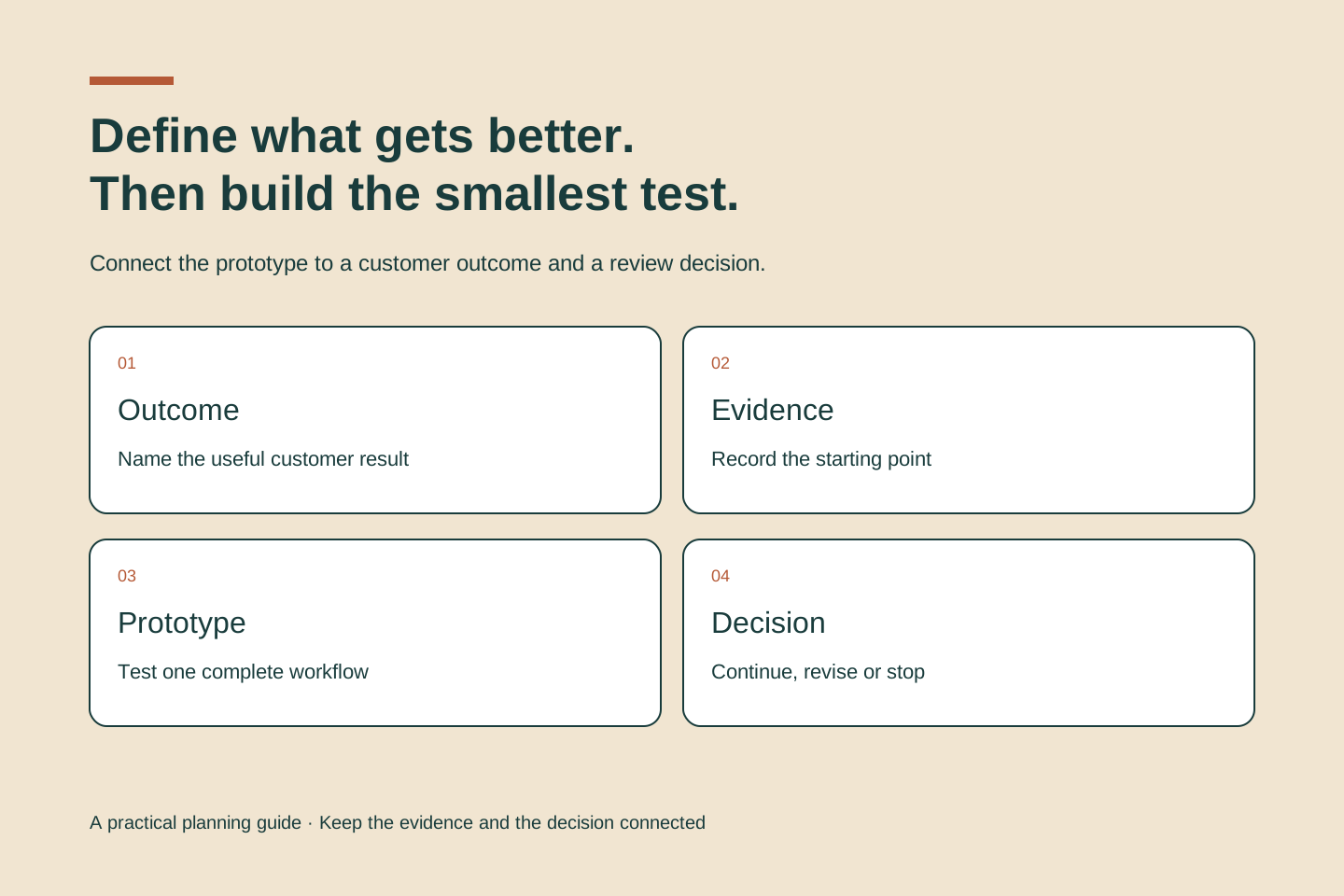
In this guide
- How do I define an outcome before building an AI prototype?
- Write the outcome before the features
- Use AI to create the smallest instrument
- Keep evidence attached to the decision
- Evaluate the tool in the real workflow
- Let the outcome govern the next feature
- Questions you might be asking
- Sources and further reading
How do I define an outcome before building an AI prototype?
Name the user, the task, and the improvement you expect to observe. Record the current process and choose a measure you can actually collect. Then build only enough to test whether the proposed change helps that task.
AI can shorten the distance between an idea and an interface. That creates a new temptation: treating the existence of the interface as evidence that the problem has been solved.
A better starting point is a change in the customer's work. What should become easier, faster, clearer, or more reliable? What would you observe if it did?
Consider a team that struggles to turn customer research into experiments. The useful outcome is not “have a research dashboard.” It is “make a traceable decision about what to test next.”
Write the outcome before the features
Describe the current friction, the person experiencing it, and the consequence. Then choose an observable signal. For our example, a useful experiment brief should connect a customer observation to a hypothesis, a proposed change, and a decision rule.
Do not assume that a faster brief is a better brief. Track whether reviewers can understand the evidence and whether the proposed test answers the question.
Use AI to create the smallest instrument
In ChatGPT Work or Codex, use Astra Extra High where available for the initial reasoning task:
Help me build a research-to-experiment workspace. First challenge whether the proposed tool addresses the stated friction. Then create one complete flow: record an observation, link its source, distinguish interpretation, draft a hypothesis, and define a test. Prepare an authorized GitHub repository, Railway deployment, and Supabase persistence. Do not fabricate research or claim that a hypothesis is validated.
Give the agent examples of a useful brief and a weak one. Explain the difference. This teaches the decision standard instead of merely the page layout.
Keep evidence attached to the decision
Store source references, the observation date, the interpretation, and the resulting action separately. A future reader should be able to see where the conclusion came from and where judgment entered the process.
Keep access appropriate to the research material. Test private records with a second account. Use fictional data while the build is being demonstrated, and document how records can be removed.
Connect the repository to Railway deliberately, with secrets supplied through environment settings and database changes recorded in migrations. Ask for a verified deployed URL, not just generated code.
Evaluate the tool in the real workflow
Watch someone turn an actual observation into a brief. Can they find the source? Do they understand the difference between an observation and a hypothesis? Can a reviewer tell what result would change the team's decision?
Compare the work with the previous method. If the tool encourages confident summaries without evidence, the interface has made the process worse even if it is faster.
Let the outcome govern the next feature
Add collaboration only if handoffs are the bottleneck. Add search when finding prior evidence becomes difficult. Add automation when the decision rules are understood well enough to repeat.
Explore Railway through our referral link if you are ready to host a focused experiment. The strongest AI build is one whose value you can explain after the novelty of the interface has worn off.
Continue with Explore more outcome-focused AI exercises.
Questions you might be asking
What is the difference between shipping a feature and improving an outcome?
Shipping means the feature is available and its behavior has been checked. Improvement means evidence shows the user’s task got better under comparable conditions. Track both, and keep uncertainty visible when a small pilot cannot establish the outcome.
Sources and further reading
- OpenAI: Get started with ChatGPT Work
- Railway: GitHub autodeploys
- Supabase: Row Level Security
- Railway: Affiliate program
Sources checked October 19, 2026. Review the linked publisher information for current details.
Put one idea to work
Define the customer outcome, smallest useful deliverable, evidence, and review decision before expanding the work.
Plan an expertise pilot →Explore more from Outcome DrivenExplore the Outcome Club signup →Keep practicing
 Customer research
Use AI keyword research to understand customer progress
Treat search language as a useful research signal, then connect it to customer tasks, journey friction, and evidence of commitment.
October 19, 2026 · 6 min read Lifecycle growth
Audit a holiday signup from the promise to the first useful result
Review a seasonal newsletter or download journey with a simple evidence sheet covering the promise, confirmation, delivery and next step.
October 18, 2026 · 3 min read