Measurement
AI visibility is an input. Measure customer progress.
Connect AI discovery experiments to a clear customer journey, honest attribution, useful outcomes, and decisions your team can act on.
In this guide
The useful starting point
Keep visibility, accurate understanding, successful action, and first value as separate measures. Use synthetic tests to find defects and real customer evidence to assess outcomes.
Start with the outcome the customer came for
A team celebrates appearing in more AI answers. Meanwhile, the people who reach its site struggle to understand the offer and leave the signup process unfinished. The visibility improvement may be real, but it does not answer whether customers are making progress.
Define the intended customer change first. For a product, it might be completing a first useful task. For a service, it might be reaching a well-informed scope decision. The measure should describe something observable, with a clear population and time window. “More engagement” leaves too much room for interpretation.
Keep four questions separate
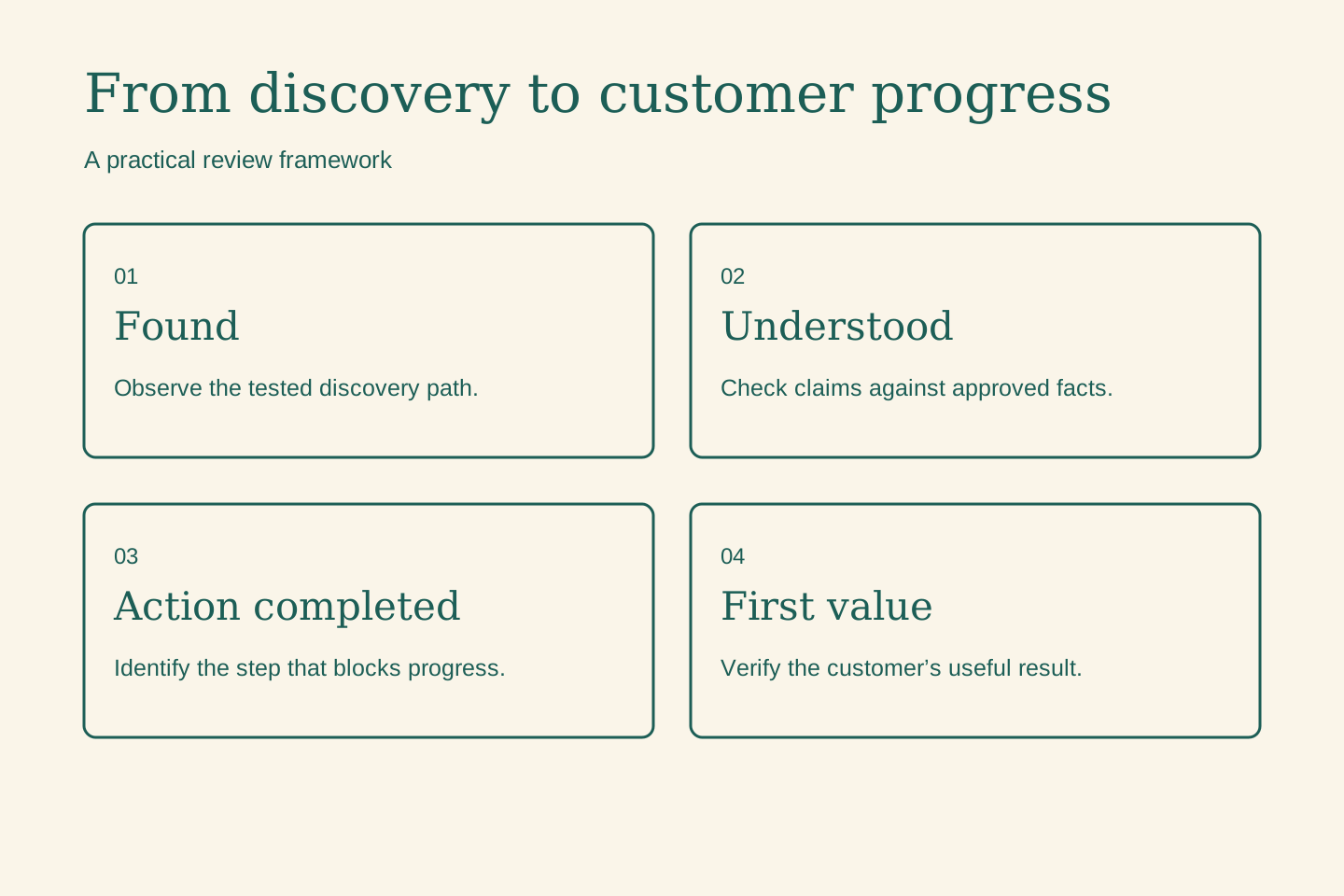
Can the offer be found? Is it represented accurately? Can the person take the intended action? Do they reach first value? Each question has a different denominator and needs different evidence.
For a synthetic audit, visibility can be the number of tested runs mentioning the offer divided by all eligible runs in the defined prompt set. Accuracy can be checked against a fixed list of verified facts. Label both as test results. They are not estimates of all shoppers or all assistant conversations.
For real visitors, define action completion among people who actually started that action, where your consented measurement supports it. Define first value among the eligible new customers in a stated cohort, within a stated period. Do not silently substitute visits, account creation, or email opens for a useful outcome.
Make the evidence record operational
Create a row for each issue with the journey stage, observed behavior, evidence, affected task, owner, proposed change, and acceptance check. A pricing mismatch belongs with the person who owns the offer facts. A form failure belongs with the person who can reproduce and repair it. An onboarding gap needs someone accountable for first use.
Use the smallest amount of customer information needed. Share aggregate findings or redacted examples where possible. A dashboard full of transcripts is not inherently more useful than a well-defined defect log and a decision.
Separate attribution from explanation
A referral source can show where a recorded visit came from. A customer can report using an assistant during research. Either can be incomplete, and neither proves that a specific page change caused a sale. Keep self-reported discovery, recorded referral, and unknown source as distinct categories.
When comparing before and after a change, note other changes in campaigns, pricing, audience mix, seasonality, and product behavior. If you lack a credible comparison group, call the result an association or observation. Use a controlled experiment when volume and implementation make it practical; do not invent statistical confidence from a few sessions.
Choose a decision before choosing a dashboard
An illustrative team discovers that an assistant frequently misstates a trial’s limits. The team clarifies the public offer and reruns its fixed accuracy checks. It also reviews real support questions and the first-use journey. Fewer mistakes in the test would support keeping the clearer copy. It would not, by itself, prove improved activation or revenue.
Set a review date and a decision rule appropriate to the evidence: fix a reproduced defect, continue collecting data, revise the hypothesis, or stop an unproductive experiment. Assign the decision to a person. Measurement should change what the team does next.
Run a one-week customer-progress review
On day one, select one offer and define first value. On day two, run a small discovery and accuracy audit. On day three, walk through the real action and delivery path using approved test methods. On day four, fix one well-supported problem. On day five, retest and review what changed.
End with a short account of findings, limitations, and the next decision. Use the following scorecard as a starting structure; populate it with your own evidence rather than benchmark numbers.
| Stage | Evidence | Decision |
|---|---|---|
| Found | Defined prompts and observed citations | Investigate missing or stale sources |
| Understood | Claims checked against approved facts | Clarify contradictions |
| Action completed | Task completion and reproduced failures | Repair the blocking step |
| First value | Eligible cohort reaching the useful result | Improve delivery or onboarding |
Plan a bounded outcome pilot and give every AI experiment a customer consequence worth investigating.
Put one idea to work
Define the customer outcome, smallest useful deliverable, evidence, and review decision before expanding the work.
Plan an expertise pilot →Explore more from Outcome DrivenExplore the Outcome Club signup →Keep practicing
 AI outcome measurement
Measure your AI agent by the work you can accept
Evaluate agent workflows using accepted results, customer evidence, review time, failure costs, and a clear definition of done.
October 23, 2026 · 4 min read Product decisions
Use AI in product development without skipping the evidence
Move from an uncertain product idea to a small, observable test while keeping customer evidence separate from synthetic feedback.
October 22, 2026 · 5 min read